This report was written by Carolyn Jenkins
and published in Black Star News on June 17, 2012
For Standing Up, Professor Faces Two Years Behind Bars
|
"Early
this year in March, Black students at Delaware State University, who
were concerned that the school was drifting from its mission, approached
Dr Jahi Issa, a history professor in Black Studies to ask for his
support in a campaign to publicize their worries.
Delaware State is a Historically Black College/University (HBCU).
Dr
Issa had written an article in the Chronicle of Higher Education and
the Black Agenda Report, an online publication, in late 2011 addressing
the inner threat that reactionary administrations pose to the future
survival of HBCUs generally. He pointed out that over the past few
decades, HBCUs have been targeted as being "too Black". Dr Issa's articles went viral.
Many
states are now trying to reduce the overall percentage of African
American students and faculty from these institutions. HBCUs have,
historically, allowed numerous Black students to escape the clutches of
poverty by providing access to affordable higher education; additional
benefits are instructors that they can better relate to, based on
similar life experiences.
Dr Issa stated in his Black Agenda
Report article: “Some HBCUs have and are going through hostile takeovers
in order to turn into White education facilities and thereby
permanently eliminating the African American middle class.”
Dr
Issa says there are also fewer Black faculty members because those who
have been retiring were replaced with White faculty. There was no
recruitment of other Black faculty replacements, he says. This also
affects enrollment as he pointed out in his Black Agenda Report article,
noting that "research shows that when African American faculty at HBCUs
is a majority, African American students tend to enroll at a higher
percentage and they tend to be more productive in the work place once
they graduate."
He calls the changes a silent, uncontested takeover.
The
threat to HBCU's existence as originally intended, to provide
opportunities once unavailable to African Americas, can't be
underestimated. Some HBCUs no longer have Black majority student bodies.
Bluefield State College, created in 1895, as an HBCU was by
2009 13% Black and 82% White; West Virginia State University, founded in
1891, is now 17% Black and 72% White. Bluefield's
transformation involved tension and turmoil. It occurred primarily four
decades ago. In 1968, a bomb exploded at a campus gym, during a time
when Black students were protesting the replacement of African American
professors with White ones. The school's administration used the
incident to shut down all the dormitories, which housed primarily
African American students. Bluefield became commuter-oriented and
predominantly White. Even though Delaware State is still 73%
African American, with 11% White, 5% Hispanic, 3% Asian, and 8%
classified as other, Bluefield and West Virginia State serve as
trend-setters for other HBCUs; both receive millions of dollars
annually. Other HBCUs with a growing White and non-African
American student and faculty population are Kentucky State University,
Elizabeth City State University and Delaware State University. When
these institutions graduate fewer African American students the economic
impact on their communities cannot be understated. It is in
this context, over the on-going struggle for the heart and soul of
HBCUs and the ongoing transformations that an incident that now
threatens Dr Issa's professional career can best be understood.
When
students planned a rally on the campus of Delaware State in March, to
express their concerns, Dr Issa agreed to support them. Dr Issa joined
the students who proposed to rally and then proceed to the Board of
Trustees meeting, which was open to the public.
Before Dr
Issa and the group of student protestors could reach the location of the
Board of Trustee's meeting, he say he was approached by uniformed and
civilian campus staff who demanded that the group disperse.
Dr
Issa says the protestors were exercising their First Amendment rights
to peaceably assemble and refused to disperse. A melee ensued and during
the fracas, Dr Issa found himself on the ground in severe pain. He was
taken to a local Hospital.
While he was being treated for a
separated shoulder --he faces possible knee replacement-- university
police charged Dr Issa with disorderly conduct, resisting arrest,
offensive touching of a law enforcement officer and inciting a riot. He
could face 2 years imprisonment.
Dr Issa emphatically denies all the charges.
Ironically,
only Dr Issa was charged; not a single student was charged. Dr Issa
has now been suspended indefinitely and the school has initiated
proceedings to terminate his employment, he says.
Some people believe
Dr Issa is being punished for his published views advocating for the
integrity of the HBCUs' mission.
Delaware State University
spokesman, Carlos Holmes, said: “DSU is just like any other
municipality. You cannot go and have a parade in Dover unless you go
through the proper channels.”
The university is in the city of Dover in the state of Delaware.
The American Civil Liberties Union disagrees.
“DSU
was not entitled to require a permit for that activity, any more than a
town would have been under the circumstances,” says ACLU Executive
Director, Kathleen MacRae. What's more, Dr Issa had contacted the ACLU the day before the rally and was told the same thing. Dr
Issa also contrasted the Administration's reaction to their rally with
what happened when the predominantly White equestrian team, in 2010,
protested its removal from the campus. This protest consisted mainly of
White students and faculty. “I witnessed it," Dr Issa recalls. "They
ran their horses around the campus, said very negative things,about the
school and its president. I witnessed it. No one bothered them.” The media also showed up and there was not a single arrest, he recalls.
Dr
Issa joined the faculty of Delaware State in the fall of 2008. He says
during the first semester, Steve Newton of the Association of American
University Professors (AAUP) walked into his office and told him: “'You
are teaching too Black and your lectures make White students
uncomfortable.'”
He says he was warned that if he was not
careful, he would be dismissed like his predecessor, Abdul Salah, whose
contract was not renewed, as was customary. Dr Issa says at that
point, he knew he was going to have a difficult time; the groundwork was
being set to get rid of him. Two phone messages left at the
History department for Steve Newton seeking comment were not returned
before publication deadline for this article. Dr Issa filed an
EEOC complaint regarding unfair and discriminatory treatment at
Delaware State. Dr Issa also approached the AAUP for assistance. ,He
was given limited help from either organizations, he says. In an
attempt to garner support for the survival of HBCUs, Dr Issa says he
met with White House Advisor on Historical Black Colleges, John Wilson,
Jr.
He said he asked: "'Will these Black colleges remain Black
or be Black 10 years from now?” He says Mr. Wilson responded by
informing Dr. Issa of the administration’s accomplishments in terms of
providing millions of dollars to the HBCUs. In 2010 the Obama
Administration announced $850 million for HBCUs over 10 years, USD100
million more than in previous years. In his Black Agenda Report
article Dr Issa quotes John Wilson, Jr as saying that HBCUs “must
not be seen as plaintiffs in the struggle for civil rights," and notes
that if it wasn't for the successes of the Civil Rights struggle,
Wilson, a Morehouse University graduate, wouldn't be serving President
Barack Obama. Dr Jahi Issa earned his PhD at Howard
University (2005), his MA at Southern University (Baton Rouge,
Louisiana), and a BA at Texas Southern University. He served as
Northeastern NC Grass Roots Coordinator for President Barack Obama’s
2008 Presidential Campaign. Until the March incident, Dr Issa had
never received anything more serious than a parking ticket, he says.
Dr
Issa says has endured a physical, emotional and financial ordeal. He
saw a wrong and wanted to make it right. His spirit has not been
deflated.
On the contrary, he’s standing firm, seeking justice the only way he knows how – through our legal system, he says. Editor's Note:
Readers feel free to support Dr Issa by calling the Delaware State
University President, Dr Harry L. Williams and Delaware Attorney
General Joseph “Beau” Biden III, and ask them to reinstate Dr Issa to
his teaching position and to drop all charges against him.
Delaware State University’s President Office: (302) 465-6001
Delaware Attorney General’s Office: (302) 577-8400 For assistance to Dr. Issa’s legal defense, please go to: Dr. Jahi Issa Legal Defense Fund and follow the prompt."
|
|
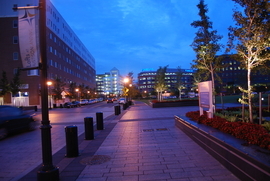
Picture above, Delaware at night next to the river in Wilmington. I took this picture after an evening networking with the Delaware Black Professionals, and organization run by Leonard Young.
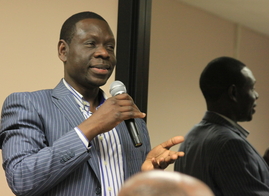
Below, Milton Allimadi, Ugandan-born publisher of Black Star News.
|
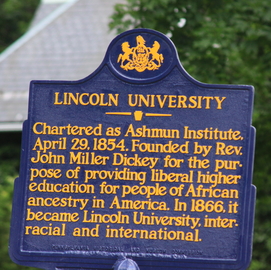
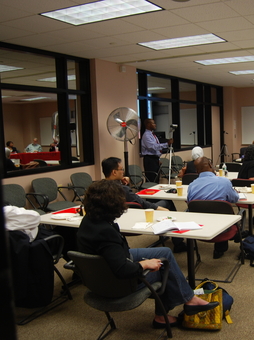
Picture above, Lincoln University is a historically Black university, click here.Picture below, Rutgers University partnered with the Center for Media and Peace Initiatives (CMPI) in a June 2012 conference on governance and media, click here.
|
Delaware State University search:
"Dr Jahi Issa
Dr Issa was awarded his PhD in history from Howard University, with a
focus on the African diasopra. His forthcoming monograph examines the
Universal Negro Improvement Association in Louisiana and its
contribution to African nationalism. Dr. Issa’s experiences extend
beyond the university, having worked in the National Archives and
Records administration, as well as working to establish libraries in
Africa.
Contact Information:
302-857-7522
jissa@desu.edu."
|
"Release from Davis-Bozeman Law Firm: In
November of 2005, Baba Mukasa Willie Ricks was invited to speak to a
class at Morehouse College. Baba Mukasa is a veteran in our struggle
forhuman rights and a life-long organizer.
Baba Mukasa was the Field
Secretary for the Student Non-violent Coordinating Committee
(SNCC-“SNICK”). Baba Mukasa worked directly with Kwame Toure (“Stokely
Carmichael”) and has organized with Dr. King and other Movement
activists.
Baba Mukasa has been arrested for engaging in civil
disobedience in the Movement but in 2005 he was arrested for
simply attempting to speak to students at Morehouse.
While waiting in
the cafeteria to speak in a class, 2 officers demanded that Baba
Mukasa leave and then arrested him.
During the arrest, Baba Mukasa, then
in his mid-60’s was roughed up by police who injured his shoulder. The
criminal trespassing charges against Mukasa were later dismissed in
Fulton County. Baba Mukasa is suing Morehouse for false arrest, false imprisonment, assault, and battery. TRIAL
– Monday June 11, 2012 at 9:00 a.m. Fulton County Courthouse at 185
Central avenue SW Atlanta, Ga 30303 Courtroom 3B before Judge Fred Eady Baba
Mukasa is represented by Attorneys Mawuli Mel Davis and Robert Bozeman
of the Davis-Bozeman law firm. Because Baba Mukasa supporters live
throughout the country we have asked the law firm to tweet updates onthe
progress of the trial.
A live feed of those tweets
(@davisbozemanlaw) can be found at www.davisbozeman.com. They will let
us know when opening statements are expected and when Baba Mukasa is
expected to testify etc. Baba Mukasa has been an
organizing and cultural mentor to thousands. He and his family have
sacrificed tremendously in an effort to push forward the struggle of
oppressed people around the world.
Please join us as we support this
freedom fighter and warrior as he demands justice for the attack and
false arrest he endured.
“They just tried to bully me. They
disrespected and hurt me. I will continue to push forward. “ Baba
Mukasa."
Originally published by Akinyele Umoja on Facebook.
|
|